Sometimes a reflection upon events that pass under my keel are enough to encourage feelings of accomplishment.
Showing posts with label Historic Ships. Show all posts
Showing posts with label Historic Ships. Show all posts
Monday, April 1, 2019

Saturday, December 14, 2013
SpoolMasterTM
Years ago I was working for Kalmar Nyckel during a winter maintenance period where we were scheduled to make a pile of new stays and shrouds. We had a few huge spools of white polyester cable and hawsers that eventually needed to be turned black for good looks and extra ultra violet light protection. "We could paint them by hand." was one suggestion.
Eventually we decided on running the cables through a half latex paint, half water solution, which works very well absorbing into the cable giving a nice coating. There was one problem. How do we effectively dry such an amount of cable without taking up too much space, getting paint everywhere, or dirt on the new cable?
And thus the SpoolMaster5000TM was born.
*images, drwing, of the painting process coming soon
Today I work with the Swedish East India Trading Company ship replica Götheborg. Here we also have our own unique problems. We make all of our own rope for rigging the ship. The material we use to make the rope is hemp, and the material we use to preserve it is pine tar. One thing is the same, the rope must be coiled.
Please welcome SpoolMaster5000TM-OldschoolEdition to the club.

No glue was harmed during the creation of this SpoolMasterTM.

I promise you, all of the joints didn't fit this neatly.
Tuesday, October 15, 2013
Should We Parcel Our Rig?
Has been some question to parcel or not to parcel. One thought is that parceling will hold in the moisture, cause rot, and thus be not worth the time and energy to clap it on.
I have seen the description of worming and parceling in some salty old books and technical descriptions of rigging from the days of tarry hemp rigs. See: "The Elements and practice of Rigging And Seamanship" Should we parcel just because someone took the time to typeset during the early days of the printing press?
When I first started sailing the Eastindiaman Gothenburg, the rigging was quite new. Some rigging had been paceled, some not. Now as she has been sailing for around a decade, I am able to get a feel for where rigging is showing signs of aging, or where it fails.
Here is a piece of rigging that has been wormed, parceled, served, and tarred between all of those steps.

Hemp stretches slowly over time, and service that is laid on can aquire a small gap inbetween each turn. Here one can see the parceling doing its job. It is holding in the tar, and in the small gaps of the service the tar has built up on top. Under the service the hemp is in very nice condition. The yarns are all clearly visible, have a nice tarry brown color, are free of rot, and unscathed.
 |
| Bumkin Outhaul / Fockhalsdävert Uthal |
 |
| Clapping on service / Klädning |
Monday, March 11, 2013

Monday, May 14, 2012
shrouds
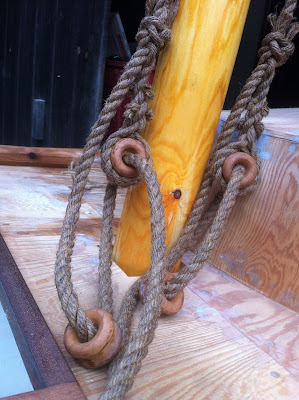
Penelope deserves a little attention, even if it is only for a few short minutes a day. Stretching hemp, splicing bullseyes, the smell of pine tar, fantastic. What is this, the Gothenburg? No, but I'm stoked regardless.
Speaking of stoked, Erik graced me with his presence today. There hasn't been two jeeps undergoing simultaneous fabrication or repair here for ages!


Speaking of stoked, Erik graced me with his presence today. There hasn't been two jeeps undergoing simultaneous fabrication or repair here for ages!

Sunday, March 15, 2009
Fid
n. a tapered implement, made of wood, iron, bone, or other dense workable material, used to aid in splicing by separating strands of a rope.
In February of this year I had the pleasure of visiting Her Majesty's Historic Shipyard in Portsmouth, United Kingdom. With two historic ships amazingly intact, and half of a preserved hull from a sixteenth century warship, the Mary Rose, this piece of history is one of a kind, and definitely well worth the visit for me. I only wish I could have spent weeks there researching those vessels.
 After inspection of the HMS Victory via a guided tour, I got to talking to Ben, the officer on duty for the day. He was very enthusiastic about the ship and eager to chat with me about her, two traits I really appreciated. I can not recall how long we were engaged in conversation. As we discussed rigging and the hull, our chats led us into a rigging workshop that is due to be demolished to make way for the new Mary Rose museum. Ben handed me a piece of copper sheeting removed from the hull as he told me about some of the various methods of preservation and maintenance, like the removal of most of the copper sheeting since the ship will most likely never touch water again, and told me to keep it. I was also graciously gifted a trunnel from the upper deck replacement and quite a large shiver of a deck beam. The people at the airport didn't seem to like my gifts as much as I did. Even though "Piece of oak" is not listed in the dangerous, do not carry on and airplane list.

Upon returning to Sweden, and after proudly showing off my cool new souvenirs, I had decided to turn the unusable hunk of history into a nice, salty, usable tool; a fid. I knew immediately that I did not want any sort of modern implement to come anywhere near my 250 year old relic, so I climbed aboard the East Indiaman and went straight for the carpenter. One of the coolest tools on board was the smithed draw knife, which was just about perfect for the job I was about to accomplish. I worked the oak into a nice shape rel relatively quickly. After completely to my liking I massaged in a couple coats of linseed oil to give it some traditional protection, not to mention a beautiful almond color.
The piece of oak was large enough to wield a nice wide 14" fid, a perfect complement to my ditty bag. I can not wait to put it to use! There is definitely some hardcore tallship street-cred to have not only a hand carved oak fid, but a relic in the ditty bag. The spirit of Nelson himself is in that fid!
In February of this year I had the pleasure of visiting Her Majesty's Historic Shipyard in Portsmouth, United Kingdom. With two historic ships amazingly intact, and half of a preserved hull from a sixteenth century warship, the Mary Rose, this piece of history is one of a kind, and definitely well worth the visit for me. I only wish I could have spent weeks there researching those vessels.
After inspection of the HMS Victory via a guided tour, I got to talking to Ben, the officer on duty for the day. He was very enthusiastic about the ship and eager to chat with me about her, two traits I really appreciated. I can not recall how long we were engaged in conversation. As we discussed rigging and the hull, our chats led us into a rigging workshop that is due to be demolished to make way for the new Mary Rose museum. Ben handed me a piece of copper sheeting removed from the hull as he told me about some of the various methods of preservation and maintenance, like the removal of most of the copper sheeting since the ship will most likely never touch water again, and told me to keep it. I was also graciously gifted a trunnel from the upper deck replacement and quite a large shiver of a deck beam. The people at the airport didn't seem to like my gifts as much as I did. Even though "Piece of oak" is not listed in the dangerous, do not carry on and airplane list.Upon returning to Sweden, and after proudly showing off my cool new souvenirs, I had decided to turn the unusable hunk of history into a nice, salty, usable tool; a fid. I knew immediately that I did not want any sort of modern implement to come anywhere near my 250 year old relic, so I climbed aboard the East Indiaman and went straight for the carpenter. One of the coolest tools on board was the smithed draw knife, which was just about perfect for the job I was about to accomplish. I worked the oak into a nice shape rel
relatively quickly. After completely to my liking I massaged in a couple coats of linseed oil to give it some traditional protection, not to mention a beautiful almond color.The piece of oak was large enough to wield a nice wide 14" fid, a perfect complement to my ditty bag. I can not wait to put it to use! There is definitely some hardcore tallship street-cred to have not only a hand carved oak fid, but a relic in the ditty bag. The spirit of Nelson himself is in that fid!
Subscribe to:
Posts (Atom)