Sometimes a reflection upon events that pass under my keel are enough to encourage feelings of accomplishment.
Showing posts with label Hemp. Show all posts
Showing posts with label Hemp. Show all posts
Monday, April 1, 2019

Saturday, December 14, 2013
SpoolMasterTM
Years ago I was working for Kalmar Nyckel during a winter maintenance period where we were scheduled to make a pile of new stays and shrouds. We had a few huge spools of white polyester cable and hawsers that eventually needed to be turned black for good looks and extra ultra violet light protection. "We could paint them by hand." was one suggestion.
Eventually we decided on running the cables through a half latex paint, half water solution, which works very well absorbing into the cable giving a nice coating. There was one problem. How do we effectively dry such an amount of cable without taking up too much space, getting paint everywhere, or dirt on the new cable?
And thus the SpoolMaster5000TM was born.
*images, drwing, of the painting process coming soon
Today I work with the Swedish East India Trading Company ship replica Götheborg. Here we also have our own unique problems. We make all of our own rope for rigging the ship. The material we use to make the rope is hemp, and the material we use to preserve it is pine tar. One thing is the same, the rope must be coiled.
Please welcome SpoolMaster5000TM-OldschoolEdition to the club.

No glue was harmed during the creation of this SpoolMasterTM.

I promise you, all of the joints didn't fit this neatly.
Wednesday, October 16, 2013
Slingerbardun

Chafe - Skav

On the old strop - På den gammal stroppen

So I shall splice up a new one - Så jag ska splitsa upp en ny

Worm, parcel, and serve - Tira, smärta, och kläda
Tuesday, October 15, 2013
Should We Parcel Our Rig?
Has been some question to parcel or not to parcel. One thought is that parceling will hold in the moisture, cause rot, and thus be not worth the time and energy to clap it on.
I have seen the description of worming and parceling in some salty old books and technical descriptions of rigging from the days of tarry hemp rigs. See: "The Elements and practice of Rigging And Seamanship" Should we parcel just because someone took the time to typeset during the early days of the printing press?
When I first started sailing the Eastindiaman Gothenburg, the rigging was quite new. Some rigging had been paceled, some not. Now as she has been sailing for around a decade, I am able to get a feel for where rigging is showing signs of aging, or where it fails.
Here is a piece of rigging that has been wormed, parceled, served, and tarred between all of those steps.

Hemp stretches slowly over time, and service that is laid on can aquire a small gap inbetween each turn. Here one can see the parceling doing its job. It is holding in the tar, and in the small gaps of the service the tar has built up on top. Under the service the hemp is in very nice condition. The yarns are all clearly visible, have a nice tarry brown color, are free of rot, and unscathed.
 |
| Bumkin Outhaul / Fockhalsdävert Uthal |
 |
| Clapping on service / Klädning |
Monday, May 14, 2012
shrouds
Penelope deserves a little attention, even if it is only for a few short minutes a day. Stretching hemp, splicing bullseyes, the smell of pine tar, fantastic. What is this, the Gothenburg? No, but I'm stoked regardless.
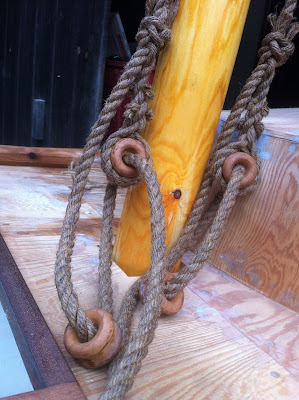
Speaking of stoked, Erik graced me with his presence today. There hasn't been two jeeps undergoing simultaneous fabrication or repair here for ages!


Speaking of stoked, Erik graced me with his presence today. There hasn't been two jeeps undergoing simultaneous fabrication or repair here for ages!

Sunday, April 22, 2012
easychair
A fun little job that puts several skills to work.
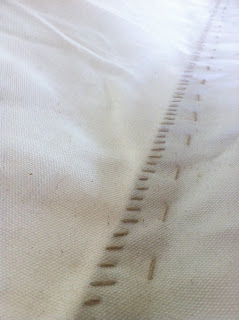
little light carpentry
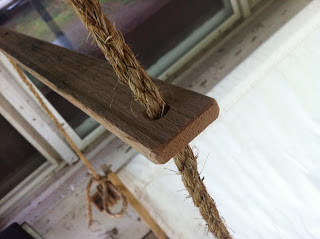
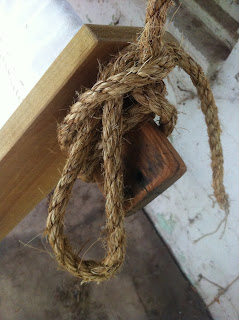

start with some sailmaking


little light carpentry


et voir là!

Wednesday, March 4, 2009
Natural Fiber
n. derived from plants or animals.
I am just graced with the awareness that 2009 is the International Year of Natural Fibers! To me this is pretty exciting. I have become a pretty strong advocate to the use of clean, well grown, natural fibers, over their polluting, carbon dioxide expelling opposites.
I imagine that probably all of you who are reading this have at least some plastic in your wardrobe. Most shoes contain a form of plastic. Materials like Polyester, Polypropylene, Nylon, Gore-Tex, etc., are are synthetics found in every-day clothing. Do you use paper towels, wet napkins, feminine hygiene products, diapers, or anything else disposable? Check closely, these items may be plastic or part plastic, and are probably at least packaged in plastic.
What is our obsession with plastic!?
There are many ways we can help nurture the environment, as well as our own lives and health; switch to natural fibers as much as possible. If you want to help, check the labels the next time you are to buy a new shirt, pants, socks, underwear, and shoes. Use wool garments instead of fleece to keep you dry when wet, hemp, flax, or cotton canvas for heavy working pants, cotton undershirts, and silk for that new bra or sexy chemise. Get dirty. Check the items you by everyday and replace those paper towels and Swiffer products with rags. Think about what is disposable, where it is going, and what impact it has on the environment. What plants are being used, how are they farmed, and is it sustainable?
So many boats out there are plastic on plastic. Plastic sails in the form of Dacron, Polyester, and Polypropelene, and many others, plastic running rigging and other small stuff like sail ties that just blow away into the sea. Why not use natural rope and sails again? On the East Indiaman Gothenburg we have been reproving that flax and hemp is an excellent material for sail making ever since 2005. Our rigging is made of hemp rope, super durable, and extremely UV resistant. We use linseed oil on our wood for preservation.
It seems as if some synthetics last longer than natural fibers. If you are unwilling to swap out to natural for everything, try just the small things. That small stuff, the stops used to furl your sails, the ones that often blow overboard and get lost to davy jones, go natural. Sail covers are just to protect your sail from the UV damage, why not a sexy hand stitched hemp, flax, or cotton cover? What about your colors? Most likely Nylon, go cotton. Like all natural fibers, dry and store them properly and it's no problem.
I appreciate every little thing you may do when going to natural fibers. Thank you.
I am just graced with the awareness that 2009 is the International Year of Natural Fibers! To me this is pretty exciting. I have become a pretty strong advocate to the use of clean, well grown, natural fibers, over their polluting, carbon dioxide expelling opposites.
I imagine that probably all of you who are reading this have at least some plastic in your wardrobe. Most shoes contain a form of plastic. Materials like Polyester, Polypropylene, Nylon, Gore-Tex, etc., are are synthetics found in every-day clothing. Do you use paper towels, wet napkins, feminine hygiene products, diapers, or anything else disposable? Check closely, these items may be plastic or part plastic, and are probably at least packaged in plastic.
What is our obsession with plastic!?
There are many ways we can help nurture the environment, as well as our own lives and health; switch to natural fibers as much as possible. If you want to help, check the labels the next time you are to buy a new shirt, pants, socks, underwear, and shoes. Use wool garments instead of fleece to keep you dry when wet, hemp, flax, or cotton canvas for heavy working pants, cotton undershirts, and silk for that new bra or sexy chemise. Get dirty. Check the items you by everyday and replace those paper towels and Swiffer products with rags. Think about what is disposable, where it is going, and what impact it has on the environment. What plants are being used, how are they farmed, and is it sustainable?
So many boats out there are plastic on plastic. Plastic sails in the form of Dacron, Polyester, and Polypropelene, and many others, plastic running rigging and other small stuff like sail ties that just blow away into the sea. Why not use natural rope and sails again? On the East Indiaman Gothenburg we have been reproving that flax and hemp is an excellent material for sail making ever since 2005. Our rigging is made of hemp rope, super durable, and extremely UV resistant. We use linseed oil on our wood for preservation.
It seems as if some synthetics last longer than natural fibers. If you are unwilling to swap out to natural for everything, try just the small things. That small stuff, the stops used to furl your sails, the ones that often blow overboard and get lost to davy jones, go natural. Sail covers are just to protect your sail from the UV damage, why not a sexy hand stitched hemp, flax, or cotton cover? What about your colors? Most likely Nylon, go cotton. Like all natural fibers, dry and store them properly and it's no problem.
I appreciate every little thing you may do when going to natural fibers. Thank you.
Subscribe to:
Posts (Atom)